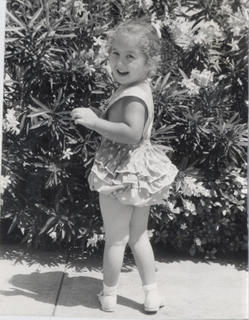
That's Panni, demure-looking in her white hat and sailor-shirted uniform, top row left. I believe this picture was taken when she still attended a Hungarian school.

Panni and Ninina, locked in a hug in our old apartamento in El Vedado.
I had a weird dream about purses and writing on walls last night--about getting to the last chapter. I'm struggling with finishing a play, as it is...and just so happen to be working on the last act, and--I think, I hope--the last two scenes. The last chapter? Is it really an ending...or a beginning?
On the seventh anniversary of Panni's passing--everything else that I've written about it so far is already on the blog--let me just add a beginning: a beginning to what may someday turn into a ???
LOVE AT A DISTANCE I
AN OUTLINE
BY GEORGINA MARRERO
It is eleven thirty a.m. on a clear, sunny Miami Monday morning in 1997. The bespectacled, slightly stooped older woman pulls up in her randomly dented blue 1988 Thunderbird in front of her favorite Cuban restaurant, the Latin American.
She does this every Monday, weather permitting. She always asks for the same plateful of ajiaco, a Cuban vegetable stew. On this particular morning, she absently stirs her soup, nibbles away on the bread, and carefully stores the saltine crackers she requested in her purse.
She’s not in Hialeah on this particular morning, however. She’s somewhere far, far away, skimming a layer of fat off of a pot that her mother has left cooling on the stove for her. It contains one of her mother’s at least thirty different varieties of soups.
It is 1927. Panni Raab is fourteen years old. She’s on lunch break from school. Tossing her books on the hall table, she rushes to the kitchen to ingest that congealed glob. It’s very good, but it’s just that: a glob.
Her mother, Ilonka, is either in another part of the house, working on embroidery, cleaning, or reading. Or she’s out visiting a friend. Her father, Zoltan, is at work at the post office in the medium-sized Transylvanian city of Arad that they call home.
And Agi, her nine-year-old sister, is in primary school. In the Lyceum, however, Panni has not only much more freedom, but also, many more responsibilities.
A wavy to curly haired brunette, tall, slim, with wire-rimmed glasses, Panni already knows she shoulders the responsibilities that would have belonged to her little brother who was born between Agi and herself. Alas, he ate a rotten apricot in the garden and died when he was a toddler.
So Zoltan is expecting great things of her. He grooms both Panni and Agi daily, reading to them from the Classics and from the great German, French, and English writers. Heinrich Heine, Anatole France, and Charles Dickens are no strangers in this house.
He also reads to the girls from Ady Endre and Petofi.
For, in the Raab household, Zoltan and Ilonka stress one thing above all else: they may now live in Romania, and have to speak Romanian at work and in school.
But they’re Hungarians first. Hungarian Jews, which pretty much means: Hungarians first; and Jews second.
There's another side to this story, too. Claro:
The Matilde farm, Las Villas province, Cuba, 1927: in the pre-dawn glimmer, the roosters are beginning to crow. Seventeen-year-old Federico Efrain Marrero y Lopez rubs the sleep out of his eyes, throws back the thin coverlet on his bed, splashes some water on his face from the washbasin in his room, and stumbles outside to the outhouse.
When he returns to the house, his brothers, Miguel and Rafael, are waiting for him. Little Guillermo, or, Sunguito, as the whole family fondly calls him, is still in bed. He’s the baby; Rosa, their mother, spoils him to no end.
The boys’ two sisters, Maria and Gloria, are already helping their mother with breakfast. Just some toast and coffee, for now: the boys will have a heartier meal later on.
Now, however, everyone has to pitch in and help with the chores. They hear the thunder of a horse’s hooves: their father, Federico, is returning from his pre-pre-dawn rounds of the farm. He calls the boys together, and assigns them their tasks for the day.
As all the boys have Federico as their first name, each boy uses his middle name. It’s Efrain’s day to feed the pigs. Not his favorite activity, he dutifully carries the slop bucket to the pen and carries out his job.
However, this is better than rolling tobacco, as he did when he was ten.
When he returns to the house, his sisters have filled the metal bath basin full of water so he can take a bath.
As the first-born son, he gets first dibs. The water is cold, but it feels good in the already stifling heat.
All the boys follow suit, dress properly, and sit down to a meal consisting of bacon, eggs, rice, fried plantains, more toast, and more coffee. It is 7 a.m.
Sunguito enters the room. Rosa immediately begins to cluck at him, just like she clucked at the chickens earlier in the morning. The two girls just stare at each other.
The other boys laugh. Rosa glowers at them. And Federico, who has just entered the house, stares impassively from one to the other. Including at Sunguito.
He doesn’t merely enter; he limps. For the patriarch of the Marrero clan was born with one leg shorter than the other. A great physician and compadre of the Marreros, Joaquin Albarran, recommended that Federico be raised in the countryside. That’s why the family spends more time on the farm than in their house in Santa Clara.
Of hardy Isleno stock, Federico and Rosa make quite the pair. Strong, brave, determined, and peculiar in their thinking, both, Federico is also quite stubborn.
Efrain is a combination of both of them. He is also quite handsome, with his dark wavy hair, and smoldering dark eyes. He’s not thrilled he has to wear glasses, but the doctor told him he needs them because he studies so much.
He wants to become a doctor.
Looking at his pocket watch, he realizes he has to run like the wind to get to school. Or, rather, ride like the wind, as he spurs his horse to ride faster and faster.
He can’t be late, for he has a very important test at 8 a.m.
He studied very hard. He wants to get the best grade in the class. His rival, Rafaelito Pedraza, may give him competition, but he’s going to give it his best.
He has to. He’s a Marrero, and he has to get the scholarship to go to medical school so he can become a doctor. Just like Joaquin Albarran.
For both of my parents, whose endings have inadvertently turned into my beginning.