The Osterizer

If you're familiar with my other blog, La Loquita del Zig-Zag, perhaps you've seen the bottom-most post, La Loquita del Zig-Zag Aterriza. As plaintively as the ever-curious, wide-eyed Brigitta von Trapp in The Sound of Music, you're squinting at me with your cute little eyes, telling me, "But it doesn't mean anything!"
OK. OK. Gather round me, let me pluck something from my Writing folder, and let me show you Ninina Mameyez' version of "Do-Re-Mi":
THE OSTERIZER
BY NININA MAMEYEZ
My mother, Ana (Panni) Raab Marrero, had a mission in life: to enlighten the natives of her adopted homeland. When she arrived in Cuba in 1941, my father took her to el campo. The Marrero finca was named “Matilde,” after my great-grandmother. The house consisted of a bohio. Strolling guitarristas were on hand to welcome her to her new home, in her new world. My father had spent ten years abroad, but he was still el hijo de un campesino… and proud of it.
As I can best recollect the story, Panni – now Ana – listened to the music that was serenading her. She then asked my father where the house was. Pointing to the bohio, he said, “There.” Ana then asked him where the bathroom was. Pepi (my mother’s nickname for my father) pointed to el platanal, and said, “There.” This was my mother’s introduction to Cuba.
The years began to pass. Panni the Hungarian was gradually being transformed into Anita la Cubana. Marrero clan members, friends of the family, and Pepi’s medical colleagues and their families adopted her as one of their own. She sterilized and helped to keep my father’s surgical instruments in good order. My parents frequented boxing matches with an extremely handsome Afro-Cuban friend of theirs. They had ringside seats. My mother delighted in matter-of-factly telling me how the boxers’ blood spurted onto their faces. It didn’t faze her, as she herself was a doctor.
Life continued. Anita complained of a stomachache. She asked a family friend, who also happened to be a doctor – an obstetrician/gynecologist, as a matter of fact – what she thought might be wrong. At almost forty-two, she was sure she was going into menopause. The other doctor examined her. “Ana, you’re five months pregnant.” And so I came to be.
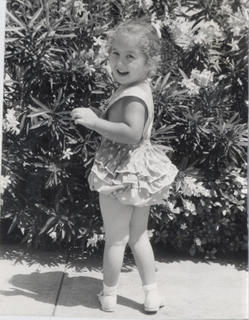
Now Anita really had to turn into una ama de casa cubana! On any given day, at least three women were in charge of me. I turned into a very fussy eater. The solution to this problem: the Osterizer.
Fruits. Vegetables. She had learned a great deal from her mother, a consummate homemaker. According to my mother, my grandmother – even in the early part of the twentieth century, before nutrition had become the rage – knew to serve both a green and a yellow vegetable at the evening meal. So, what do you think went into that Osterizer? Vegetables. I must have at least tolerated them, because I still eat them.
Something went wrong when it came to the fruits, however. Perhaps I was fed one too many jars of Gerber strained prunes? My mother, however, had not for one moment lost track of her mission.
Company. The help. No one was spared my mother’s fruit salad. There were many wonderful kinds of fruits available in Cuba, many of which joined us on our journey to El Exilio: platano, frutabomba, mango, mamey. I’m sure they all found themselves in Anita’s fruit salad, at one time or the other. And some of them ended up in delectable batidos.
La Sauwesera, 1960: many of us were now in Miami. Enough of us that my mother felt she had to continue with her crusade. Get-togethers, birthday parties, my father’s lunch, whatever: out came the fruit salad. By this point, I had become one of the initiated. And an unwilling one I was, too.
Years later, Mami tried to teach me her “trick” to make the fruit salad palatable. She “doused” it in orange juice. Perhaps something a little stronger would have appealed to me more? I’ve got to hand it to her: she was tenacious.
During the nineties, I finally began to pay attention to what she put in the salad. By this point, I could handle most of it… except for the strawberries. Mushy, gushy, yuck! Perhaps I was envisioning the concoctions created for me in that dreaded Osterizer, instead?
To this day, I remain Panni Raab Marrero’s most “unenlightened” convert. It’s not her fault that I don’t like strawberries, for I really don’t. I assiduously remove them from those Fruit’nYogurt Parfaits they sell at McDonald’s. I carve them out of the yogurt, and contemptuously dump them onto the domed plastic container covers. I don’t care who’s looking. However, my mother’s prized Osterizer has a special place in my kitchen. I’ve made some great frutabomba batidos with it, as well as a daiquiri or two.
Needless to say, they’re not strawberry daiquiris.
El Exilio – exile (the name Cubans have given to living in the United States).
La Sauwesera – the fond nickname Cubans have given to the Southwest section of Miami, on and around Calle Ocho.
Copyright, 2003 by Ninina Mameyez 770 words First-time worldwide serial rights
posted by Ninina Mameyez @ 1:29 PM
0 comments